Showing posts with label Eilat. Show all posts

Friday, July 9, 2010

The Red Canyon

A gigantic red rock guards the entrance to the Red Canyon.

A remarkable geological structure lies not far from Eilat in the heart of the Negev desert - The Red Canyon. This is a very narrow, serpentine canyon cut into the red rocks of a huge wadi, Nachal Shani, only a shoulder-width wide in many places, and towering over 100 feet as it winds to its conclusion. The Red Canyon itself is not very long, less than a quarter mile, but the return trip has to be made from up top, where there is some exposure to falling into the Canyon itself. There are hand grips and ropes in a few places to ease the climbing for the return trip.

"A" marks the spot of the entrance to the Red Canyon. (As always, click for full-size images.)
Explore this location here on Google Maps

Red Canyon as seen on Google Earth. (Parking lot with tourist busses seen on left.)

The entrance to the Red Canyon is through a hike down the broad Nachal Shani that begins about a quarter mile from the parking lot off Route 12 to/from Eilat. The hike to the wadi itself from the parking lot is another quarter mile, giving a total distance of just over 1/2 mile from the parking lot to the beginning of the Canyon. In the summer months you should bring water as it can be very hot here.

Panoramic view of entrance to the Red Canyon (on right).
Click for full size image.

The wadi gives no advance warning that you are about to enter this extraordinary canyon. All of a sudden a gigantic red rock appears in the middle of the wadi and then the wadi suddenly narrows as you enter the mouth of the Red Canyon, which rapidly encompasses you as you continue your hike. It goes from being just a few feet deep to winding narrowly 100 feet above you in a matter of 100 meters.

Entering the Red Canyon

Gazing up from the floor of the Red Canyon.

One of a number of vertical drops encountered while traversing the Red Canyon.

The Canyon itself has a number of steep, vertical drops of about 10 feet which rapidly deepen its height to over 100 feet above. The way down these drops is eased by the installation of steel hand holds that allow the hiker to ease his or her way down them. But they also make return via an out and back route almost impossible. One must climb to the rocks above the canyon and scurry back that way.

Exiting the Red Canyon.

Stuck atop the Red Canyon.

The Red Canyon as see from above.
   

Wednesday, June 30, 2010

Fast of the 17th of Tammuz and One of the Hottest Days of the Year

There was a heat wave throughout Israel for this fast day, the Fast of the 17th of Tammuz. In Mitzpe Ramon at 2:30PM the temperature was 96F. In Be'er Sheva, which we also visited today, the temperature was 102F at 3:45PM, with an oppressively hot desert wind just making it feel worse. Eilat had a high of 109F today!

By sunset in Mitzpe Ramon the temperature had been brought down to 81F at the Har Gamal Lookout, with humidity of 38% and a strong westerly wind at the crater's rim of 30mph. At least the wind was cool, unlike the hot blast we experienced in Be'er Sheva.

Given the heat, and the fact also that it was a fast day, there were very few people out and about in Be'er Sheva, and traffic in the city was at a minimum. It was a good day to be inside with air conditioning, contemplating the history of the Jewish people, or just waiting out the Fast Day.

We spent it getting a chest x-ray for Pam which is a routine study required before her knee surgery. We accomplished our mission in record time, perhaps because everyone was reluctant to go out. The only other time I have seen Be'er Sheva with fewer people and less traffic was on a Friday afternoon when the streets were almost completely empty. You might want to bear this in mind, if you're looking for a time to get things done in a hurry in Be'er Sheva.

The heat gets the better of an ice cream cone in Be'er Sheva today.


Wednesday, June 9, 2010

Route 12 to Eilat - The Black and White Cranes

Most people going to Eilat take either Route 40 to Route 90, which runs down the Jordan River and Arava Valleys, or Route 90 all the way. Route 12, which branches off Route 40 about 80 kilometers from Eilat, is almost completely ignored. Route 12 runs down the Israeli/Egyptian border and covers some of the most beautiful mountains and flowered desert plains in Israel. In addition, the highway is the equal of Route 40 in quality and better in speed, since there is so little traffic on it.

Route 12 to Eilat.

Many of the mountains are huge, basalt monoliths, cooled magma from underground that was thrust up through fissures created by the motion of the African, Arabian and Indian tectonic plates which meet under the Red Sea.


A panoramic view of Mt. Shlomo as seen from Route 12. (Click for full-size images.)

Driving Route 12 on our way home from Eilat we happened upon a flock of Black and White Cranes. These large, beautiful birds can be seen near road sides in the spring when they migrate north from Africa to their breeding grounds in Europe. I had seen a flock before on Route 40 but wasn't able to stop. This time I did and got some wonderful photos of these birds.

A panoramic view of Black and White Cranes along Route 12.

The desert plains are beautiful in the early spring (April in this case), festooned with wild flowers as far as the eye can see. Going down to Eilat we crossed one valley that was filled with small yellow wild flowers all the way to the horizon. These were some of the wild flowers the Black and White Cranes were grazing among.

Desert wild flowers.

Tuesday, June 1, 2010

Shizafon Junction - An Oasis in the Desert

On the way to Eilat from Mitzpe Ramon, we descend from the high desert toward the Arava Valley. Route 40, the only road south from Mitzpe Ramon, intersects Route 12 at the Shizafon Junction, about 80 kilometers from Eilat. Most people continue down Route 40 to Route 90 which continues down the Arava Valley directly to Eilat. But Route 12 is another option, much more scenic, and much less travelled. You can just about drive Route 12 with your eyes closed there is so little traffic on it. Yet it is the most scenic route to Eilat, passing through the mountains that define the Israeli side of the Arava Valley, with many large mountain vistas to engage the traveller. There are also some stunning sites of natural wonder, like the Red Canyon, which we shall visit in another post.

Shizafon Junction (A), where Route 40 meets Route 12

In any case, at the junction of 40 and 12, the Shizafon Junction, is a little Inn that is an oasis in the Negev desert. There are fountains and streams of water with verdant green plantings and flowers everywhere. You can enjoy a meal or drink in the shade of the garden or indoors at the restaurant. It also makes for a good rest stop for the kids with excellent bathroom facilities. Continue on to your destination refreshed from there.

Tables and garden at the Shizafon Junction (Click for full size image.)


Green pond with algae and who knows what else?


Thursday, May 27, 2010

Leopards and Wolves and Foxes (Oh my!) - The Predators of the Chai Bar Nature Preserve

About 40 kilometers north of Eilat on Route 90 lies the remarkable Chai Bar Nature Preserve. This large and open preserve sits in the red heart of the Arava Valley, surrounded by the Red Mountains of Jordan and the sandstone cliffs of the Israeli Negev. It is home to a variety of wild life that used to flourish in Israel and that are mentioned in the Torah.

Descending from the High Desert of the Negev to the Arava Valley, red as the heart of a watermelon, the Red Mountains of Jordan face us on the other side. (Click for full size images.)

The predators, snakes, birds and small creatures are all housed in a glassed-in area that opens to the desert all around, giving a sense of space to the cages while still protecting animals and visitors alike.

The predators are some of the showcase animals of the preserve. Wolves and foxes, nocturnal creatures for the most part, are still found in the desert. The wolves travel in small packs of 3-4 while the foxes are mostly solitary. They can be seen at night by the careful observer at the edges of developed areas in the desert. The wolves and foxes are no fools and want their meal as easy as the next fast-food junky. They hang around farms and garbage dumps looking for an open chicken coop or food waste. If you travel off-road with a four-wheeler and a bright (1 million watt) light, you can see their eyes and ghostly bodies reflected in the beam.

Desert wolves at the Chai Bar Animal Preserve

Blue-eyed, large-eared, bushy-tailed desert fox (Click to see his eyes better)

The prize predator in all of the desert is the leopard. It is hard to believe that an animal so closely associated with the African forest is to be found in the Negev, but Sinai and Israel used to be filled with them. As G-d tells the Israelites in the desert:
28And I will send hornets before thee, which shall drive out the Hivite, the Canaanite, and the Hittite, from before thee. 29I will not drive them out from before thee in one year; lest the land become desolate, and the beast of the field multiply against thee.  -- (Exodus 23)
 The leopard, top predator in a parched land

It is currently unknown how many wild leopards remain in the Negev, but estimates run around seven. A few years ago one broke into a home in the Kibbutz of Sede Boquer where the owner, who happened to be a naturalist whose expertise was the leopard, threw a blanket over it and managed to wrestle it to the ground while waiting for help. The animal died soon thereafter, as it must have been very sick to even try breaking in to an occupied home. The only place that signs are placed about wild leopards today in Israel is at the Dead Sea, but none have been seen there in years.

Desert leopard (Panthera pardus).
All the world's a stage,
And all the men and women merely players;
They have their exits and their entrances,
And one man in his time plays many parts,
His acts being seven ages... Then a soldier,
Full of strange oaths and bearded like the pard,
Jealous in honor, sudden and quick in quarrel,
Seeking the bubble reputation
Even in the cannon's mouth. - Shakespeare,"As You Like It"


The leopard is amazingly agile and fast. This one bounded into the bower of the tree in three lithe leaps (he did it faster than you can say it :) first into the notch, second into the bottom of the bower, finally into the bower itself, all in one smooth motion. Well camouflaged, you are dead meat should you walk beneath.

Can you find the leopard in the tree?

In our next post we will write about the safari experience at Chai Bar and Jurassic Park!


Monday, May 17, 2010

Coming into the Country

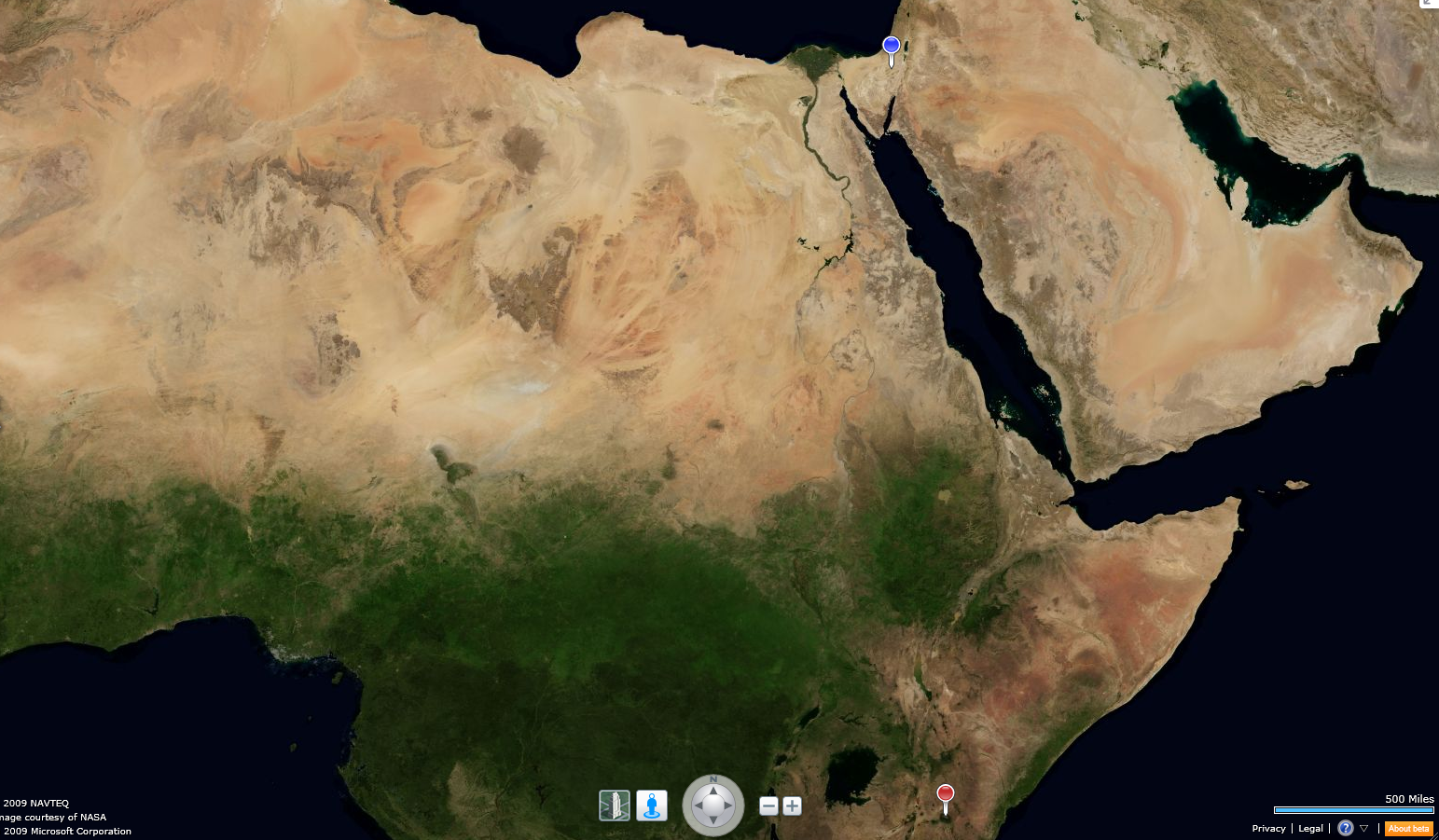
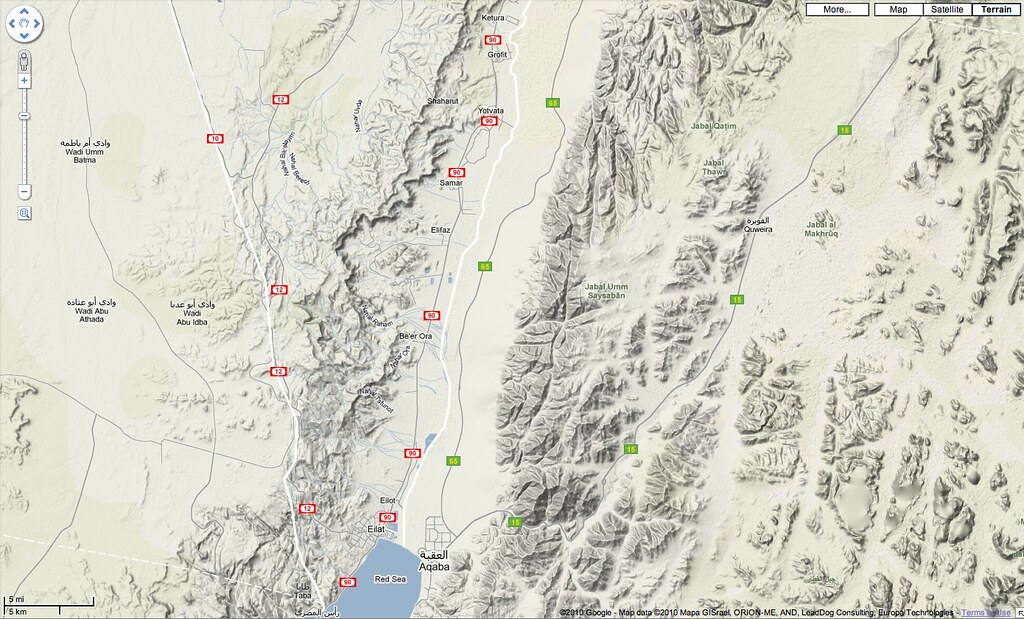
Descending toward the east from the high desert of Mitzpe Ramon the Aravah Valley is one of the most striking geographical features we encounter. Also called the Jordan Rift Valley, it is a continuation of the Great African Rift Valley that begins 5000 miles south in northern Tanzania and is responsible for monumental geological features such as Mt. Kilimanjaro.

Great African Rift Valley system starting just below the red pin (Mt. Kilimanjaro) and running over 5000 miles north to the Aravah Valley between Israel and Jordan

I have always loved the sound of the name "Great African Rift Valley". It was discovered by British explorer and geologist John Walter Gregory on an expedition in 1892-3. Although now considered to be a number of related faults, rather than a single entity, the Great African Rift Valley conjures up far away mysterious places where wild animals call dangerously and the earth can swallow you up without a trace.

In Gonwonda land did Lawd decree
A great and steamy Tethys sea;
Where Jibjubs burbled and the Plythes did play
All throughout a Paleolithic day.


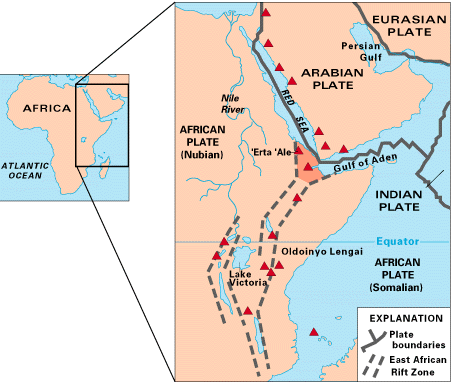
As the Arabian Plate pulls away from the African Plate, and the Indian Plate collides with both, the Great African Rift Valley and the Aravah Valley are formed.


Tectonics of the Great African Rift Valley and the Aravah Valley


Where the Great African Rift Valley enters the Middle East it becomes the Jordan Rift Valley, and farther north the Jordan River Valley itself. It is actually a fault in the earth's crust caused by the separation of the Arabian Plate from the African Plate as the Arabian Plate moves away, pulling to the northeast. Nowhere is this fault so prominent as where it runs between Jordan and Israel in the south, starting at Eilat from whence it runs north, becoming the depression that forms the Dead Sea, the lowest point on earth, and continuing north as the Jordan River Valley, The Sea of Galilee, eventually petering out in Northern Syria as the Bekaa Valley, home to various terrorists and other thugs. It is responsible for much of the geography and hence politics of the Middle East.

One encounters it all of a sudden, descending the serpentine road of the high desert, when the Aravah Valley suddenly heaves into view.


The valley itself is wide and flat, as much as 5 miles wide at its greatest width, and very red in color, with sharp, soaring peaks of basalt rising in three tiers to 5000 feet on the Jordan side (Arabian Plate), and lower, softer, terrace-eroded cliffs of sandstone on the Israeli side (African Plate). As one drives down Israel's Route 90 towards Eilat, the mountains on the Jordanian side become more sheer and ever  higher, while the sandstone cliffs on the Israeli side become milder. The Thethys Ocean once covered this area some 220 million years ago. The Valley disappears into the sea when one reaches Eilat Bay, but the mountains continue to soar up until out of sight of land.

The Red Mountains in Jordan, forming the eastern boundary of the Aravah Valley

The terrain on each side of the fault is quite different, perhaps because of the fact that each belongs to a different tectonic plate with a different history.

Cliffs on the Israeli side of the Aravah Valley, forming the western boundary

Topography of the Aravah Valley, just north of Eilat
   

Tuesday, April 13, 2010

Into the Sea


Today, Monday April 12, is a week since Shevei shel Pesach, the seventh day of Pesach, on which the Jews crossed the Red Sea and completed their escape from Egypt. It is also the day on which Yom Hashoah, Holocaust Remembrance Day, is celebrated, recalling the events of the Shoah during which European Jewry did not escape from Hitler's Final Solution.

We were in Eilat for the end of Pesach, somewhere very near where the "Yam Suf" split and the Jews crossed. It is uncertain exactly which body of water is referred to in Exodus. There is an excellent article published in the OU's "Jewish Action" which analyzes where this location may have been from a Biblical and archeological perspective. There is no definitive conclusion but evidence points somewhat in favor of it being the Gulf of Suez arm of the Red Sea. Eilat is on the Gulf of Aqaba arm of the Red Sea, on the other side of the Sinai peninsula.

Possible Routes of the Exodus and splitting of the "Yam Suf"

If the Exodus occurred along the southern purple route, the Jews would have crossed the Gulf of Suez where it is about one mile wide. From our visit to Eilat I can tell you that the Red Sea is one of the most prolific bodies of water home to all sorts of fantastic corals and fish. (See slide show above.) The photos above are from the Oceanarium at Eilat. Although this seascape is so dense it looks artificial, it is entirely natural. The Oceanarium was sunk into the waters near shore and all of the fish and coral occur there naturally.

This gave rise to a different thought about the splitting of the Yam Suf: "And the Jews crossed over on dry land." I had always thought of the "dry land" as being the opposite of "mud". However, after visiting the Oceanarium, I can tell you that this is not what is at the bottom of the Red Sea. It is filled with the most fantastic and huge corals, together with giant rocks and boulders that would have made passage impossible. From this I surmised that if G-d had not turned the sea bottom into dry land, the Jews would have had the impossible task of crossing over giant coral formations, and gigantic rocks and boulders, not slogging through mud. 

So this trip to Eilat gave me a fresh image of the perils of what the Red Sea crossing would have been like, had it not been for G-d's miracles.


Friday, April 2, 2010

In Eilat for Pesach

We are in Eilat with our friend Rachel and her daughter Rebecca for the end of Pesach.  We are staying with an American tour group led by Rabbi Stewart Weiss from Rannana  in the Orchid Hotel, an Eilat favorite of many Israelis.

Rachel and Rebecca

The Orchid is built in to the side of the Eilat mountains, so it is a very vertically oriented hotel with direct outdoor access from almost all of the rooms.The hotel's architectural theme is, oddly, Thai/Bhuddist. The rooms are stand alone suites with a high-peaked "A" frame construction, decorated inside with bamboo walls. Each room has an outdoor balcony that faces the Gulf of Eilat, and an upper loft inside, accessible by a retractable ladder, with a bed. Lots of fun for kids.

Orchid Hotel, Eilat, built into the side of the mountain

View from hotel room balcony. Gulf of Eilat and the Jordan Red Mountains with Eilat Oceanarium tower to left foreground.

Some people consider digital photography a curse, because instead of enjoying their vacations, they sit around processing their photos, uploading and sharing them, not seeing the sights or enjoying a good nights sleep. Not me. I consider it part of the fun. What could be better than sitting here in the shade of an Eilat hotel, watching the people and water, and playing with my blog.

Orchid Hotel pool and deck with the Gulf of Eilat and Red Mountains in the background. It's a hazy day today with temps in the mid 90s. Still quite pleasant in the shade.
  

Tuesday, March 23, 2010

Barbara from Eilat

Today I met Barbara from Eilat at the 'neto. She is a retired interior decorator with the Isratel Hotel chain. She lives in Eilat and was traveling north to explore the spring scenery in the northern part of the country. She is German, has been in Israel for 20 years and speaks at least German, Hebrew, and English fluently and mostly without an accent. She said she had seen me at the 'neto before. (I do spend alot of time there.)

We agreed that given what the current work environment looks like, it's better to be happily retired than unhappily employed. We both said we worried what our childrens' work lives and careers would be like, since we didn't envy people just entering the work force. This not simply because of the Great Recession, but because the modern work place has become such a pinched, selfish, mean spirited, hyper-competitive, and political place to be. Well, those are my thoughts on the matter in a very small nutshell.

Barbara of Eilat
  

Thursday, February 18, 2010

If You Can't Scuba Dive, Might as Well Mud Dive

The torrential winter rain storms of January 17-18 cut off travel along Route 40 at a number of places. The road between Sede Boker and Mitzpe Ramon was severed by overflowing wadis in several locations and there were major floods along Nachal Paran, south of Mitzpe Ramon toward Eilat.


Route 40 between Sede Boker and Eilat


One major area of flooding was in Sede Boker, right at the entrance to Ben Gurion's desert home and his burial place overlooking the Ein Avdat Valley.
  
Flooding at Sede Boker and Ben Gurion's desert home and burial site. Note the overturned bus stop.


With the main road south to Eilat blocked for several days, tourists were forced to improvise their vacation plans.


What's a tourist to do if you can't get to Eilat?


 If you can't scuba dive, might as well mud dive. Let me tell you, that water is COLD!
 

Related Posts with Thumbnails